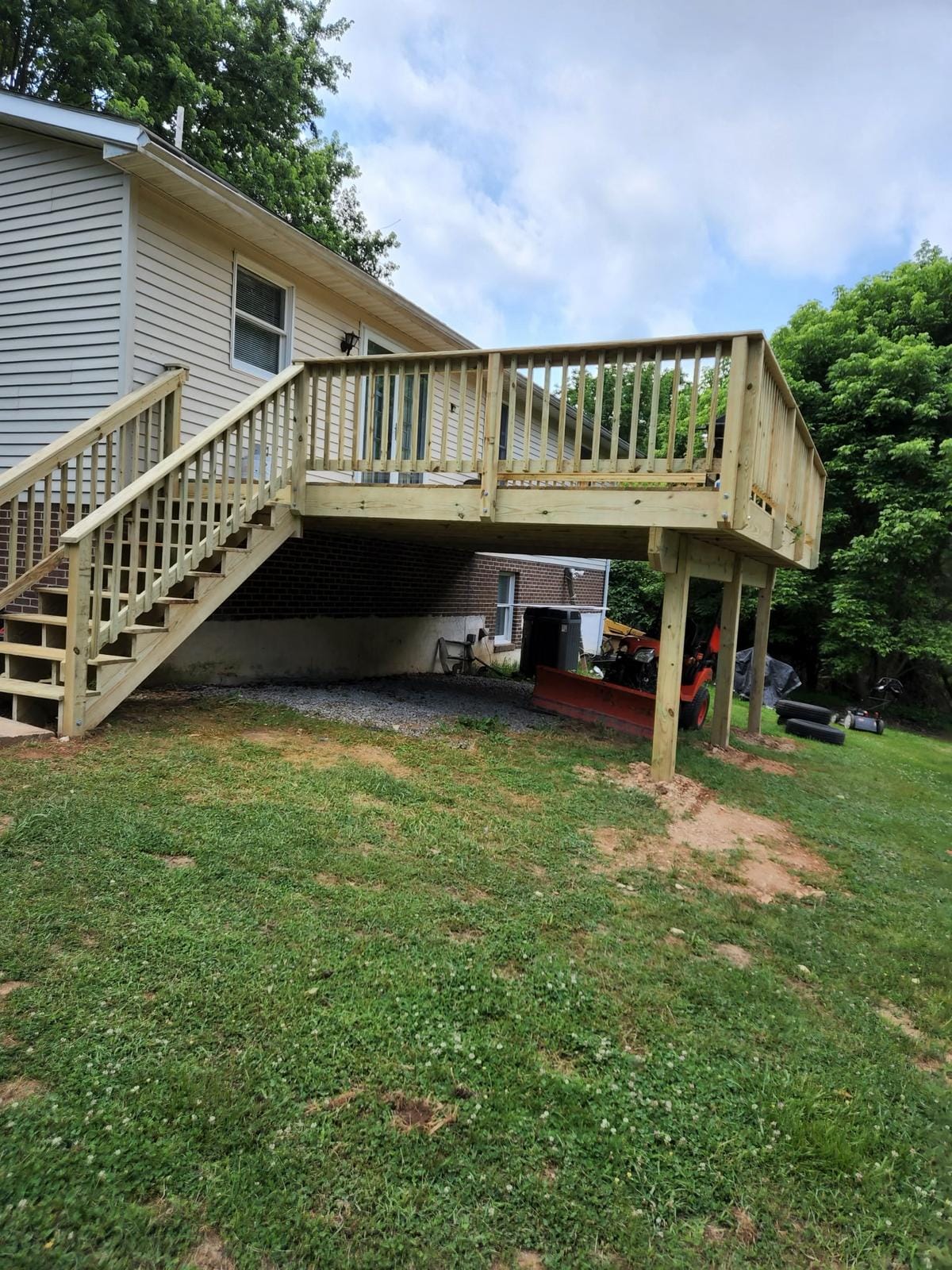
"What's a deck going to cost me?" is the first question almost every homeowner asks — and the honest answer is "it depends," because two decks the same size can differ by tens of thousands of dollars. Here's a straight, 2026 breakdown of what actually drives deck pricing in Northern Virginia, so you can budget with real numbers instead of guesses.
- Most new NoVA decks run about $30–$95 per square foot installed in 2026.
- Material is the biggest single factor — pressure-treated is cheapest, composite and PVC cost more but barely need upkeep.
- Height, stairs, and railings often move the price more than the decking itself.
- A typical mid-size deck commonly lands in the $12,000–$30,000 range — but only an on-site estimate is accurate.
Cost by decking material
The material you pick sets the baseline. These are typical installed per-square-foot ranges for Northern Virginia in 2026 — material plus labor, framing, and standard railing:
| Material | Per sq ft (installed) | Upkeep |
|---|---|---|
| Pressure-treated pine | ~$30–$50 | Stain/seal every 2–3 yrs |
| Cedar | ~$40–$60 | Seal periodically |
| Composite (Trex, TimberTech) | ~$60–$95 | Wash only; 25–30+ yrs |
| PVC / premium capped | ~$85–$110+ | Wash only; longest life |
Ranges are 2026 ballparks for planning only. Lumber and composite prices move, and every lot is different — your real number comes from an on-site estimate.
What that means in real totals
Multiply the rate by your square footage and you get a working budget. Here are common deck sizes at a typical build:
| Size | Approx. sq ft | Pressure-treated | Composite |
|---|---|---|---|
| 12 × 16 | ~192 | ~$6,000–$10,000 | ~$12,000–$18,000 |
| 14 × 20 | ~280 | ~$9,000–$14,000 | ~$17,000–$26,000 |
| 16 × 24 | ~384 | ~$12,000–$19,000 | ~$23,000–$35,000 |
Notice the per-square-foot rate eases as the deck gets bigger — fixed costs like permits, footings, and stairs spread across more area. A larger deck costs more overall, but you tend to get more deck per dollar.
What actually drives the price
Two quotes for the "same" deck can be wildly different because of what's underneath and around it:
- Height off the ground. A raised second-story deck needs deeper footings, taller posts, more framing, and a full staircase — often the single biggest jump in cost over a ground-level build.
- Railings. Basic wood rail is cheapest; aluminum, cable, or glass systems can add thousands across a full perimeter.
- Stairs and landings. Every run of stairs is framing, footings, and labor on top of the deck itself.
- Site access and terrain. A sloped, rocky, or hard-to-reach yard means more digging and hand-carrying — and more hours.
- Tear-out of an old deck. Demolition and haul-away of an existing structure adds to a replacement.
- Permits. Most NoVA decks require a permit (see our Fairfax County deck permit guide) — a real, budgetable line item.
- Extras. Built-in benches, lighting, a pergola, or multi-level layouts each add cost — and value.
This is also why a suspiciously low quote can cost more later. Undersized footings, a nailed-instead-of-bolted ledger, or skipped flashing save money on day one and fail expensively down the road.
Wood or composite: which pays off?
Pressure-treated wood wins on upfront price, and a well-built wood deck can last a long time — but it needs cleaning, staining, and sealing every couple of years to get there. Composite and PVC cost more to install, then ask for almost nothing beyond an occasional wash, and hold their color for decades.
Over the full life of the deck, the two often even out: you're really choosing between lower cost now with ongoing maintenance (wood) or more now and very little later (composite). If you plan to stay in the home a long time or hate yard chores, composite usually wins on total value.
Skip gives a flat, itemized estimate after seeing your yard — material, framing, railings, stairs, permit, and any tear-out, spelled out so you know exactly what you're paying for. No vague per-foot number, no surprise add-ons mid-build.
He's been building and repairing decks across Northern Virginia since 1979.
Frequently asked questions
How much does a deck cost in Northern Virginia?
As a 2026 ballpark, most new decks run about $30–$95 per square foot installed, depending mainly on material and complexity. A basic pressure-treated deck sits at the low end; composite or PVC with metal railings and stairs sits at the high end. A typical mid-size deck often lands in the $12,000–$30,000 range — but the only accurate number is a free on-site estimate.
How much does a 12x16 deck cost?
A 12×16 deck is about 192 square feet — roughly $6,000–$10,000 in pressure-treated wood, or about $12,000–$18,000 in composite once you add railings, stairs, and footings. Elevation, site access, and railing choice move the number more than the decking itself.
Is composite decking worth it compared to wood?
Composite costs more up front but doesn't need staining or sealing and typically lasts 25–30+ years with just washing. Wood costs less to install but needs regular refinishing. Over the deck's life the two often even out — it's higher upfront cost traded for far lower upkeep.
What's the most expensive part of building a deck?
After the decking material, height and structure. A raised deck needs deeper footings, taller posts, more framing, and stairs, and elevated decks require code guardrails. Premium railings, multi-level layouts, built-in seating, and tough site access also add meaningfully.
Is it cheaper to repair or replace a deck?
If the framing, posts, and footings are sound and only boards or railings are worn, a repair or re-decking is far cheaper than a rebuild. If there's structural rot, an unsafe ledger, or failing footings, replacement is usually the better value. Skip will tell you honestly which one your deck needs.